
The Ultimate Digital Marketing Strategy for Multi-Specialty Hospitals in 2026
Introduction: The Complexity of the Multi-Specialty Giant
Marketing a multi-specialty hospital is not like marketing a standalone dental clinic or a boutique dermatology center. It is the equivalent of running a dozen different businesses under one unified roof.
The patient journey for an expecting mother looking for a maternity ward is entirely different from an athlete searching for ACL reconstruction, or an elderly patient needing emergency cardiac care. They have different fears, different questions, and completely different search behaviors.
If your hospital uses a “one-size-fits-all” marketing approach—relying solely on generic newspaper ads, hoarding boards, and a basic website—you are burning your marketing budget and losing high-value patients to hyper-specialized boutique clinics.
To thrive in 2026, healthcare organizations need a sophisticated, data-driven digital marketing strategy for multi specialty hospitals. At Peakora, we have engineered a highly specific framework designed to lower your overall Patient Acquisition Cost (PAC) while maximizing revenue across every single department. This is the exact blueprint.

Chapter 1: The “Hospital-as-a-Platform” Website Architecture
Your hospital’s website cannot be a digital brochure; it must be a high-converting patient acquisition engine. The biggest mistake multi-specialty hospitals make is dumping all their services onto one or two pages. This confuses patients and destroys your SEO.
The “Silo” Structure for Departmental Dominance
To rank on Google and provide a seamless patient experience, your website must be structured in “Silos.” Every major department must have its own dedicated micro-ecosystem within your site. For example, your Department of Orthopedics shouldn’t just be a single page. It should be a hub:
- /orthopedics/ (Main Hub Page introducing the HOD and team)
- /orthopedics/knee-replacement/ (Specific Procedure Page)
- /orthopedics/sports-injuries/acl-tear/ (Specific Condition Page)
Why does this matter? When a patient searches for “Robotic Knee Replacement Surgeon near me,” Google wants to send them to a highly relevant page about knee replacements, not a generic hospital home page.
The 3-Second Conversion Elements
Once the patient lands on these specific pages, your UI/UX must guide them instantly toward an action. Every departmental page must include Doctor Profiles with credentials, Social Proof via video testimonials, and a Frictionless Booking button linking directly to the department’s front desk.

Chapter 2: Search Engine Optimization (SEO) for Clinical Intent
General healthcare keywords (like “hospital near me”) are incredibly competitive and often yield low-quality traffic. A successful digital marketing strategy for multi specialty hospitals relies on High-Intent Long-Tail SEO.
Mapping the Patient Journey to Search Intent
Patients go through three stages of search before walking into your hospital. You need content for all three:
- The “Symptom” Stage (Top of Funnel): Patient searches “Causes of chronic lower back pain.” You provide educational blog posts written by your doctors to build early trust.
- The “Condition/Treatment” Stage (Middle of Funnel): Patient searches “Angioplasty vs Bypass Surgery differences.” You provide detailed procedure pages explaining risks and benefits.
- The “Provider” Stage (Bottom of Funnel – High Intent): Patient searches “Best cardiologist in City.” You provide optimized doctor profiles and pricing transparency.
The E-E-A-T Principle for Medical SEO
Google treats medical websites under the YMYL (Your Money or Your Life) category. To rank, your content must demonstrate Experience, Expertise, Authoritativeness, and Trustworthiness (E-E-A-T). Every blog post and procedure page must have an author bio linking to the respective doctor’s profile.
Chapter 3: The Google Maps “Multi-Listing” Ecosystem
Local SEO is the battleground for emergency and out-patient department (OPD) visits. For a multi-specialty hospital, managing Google My Business (GMB) / Google Business Profile is highly complex but incredibly lucrative if done correctly.
The Departmental Listing Strategy
Google guidelines allow multi-specialty hospitals to create separate GMB listings for distinct, forward-facing departments, provided they have distinct signage or entrances. Instead of one listing, you should have:
- City General Hospital (Main Listing)
- City General Hospital – Department of Cardiology
- City General Hospital – 24/7 Emergency Room
The Benefit: When you separate these listings, your Cardiology department can choose “Cardiologist” as its primary category, allowing it to rank #1 when a patient searches specifically for heart doctors.
Practitioner Profiles
Your senior consultants should have their own “Practitioner Profiles” nested at your hospital’s address (e.g., “Dr. Anil Kumar – Neurologist at City Hospital”). This dominates the search engine results page (SERP), pushing competitors off the page.

Chapter 4: Precision Paid Advertising (Google & Meta Ads)
If SEO is a long-term investment, Paid Advertising (PPC) is the immediate cash-flow generator. However, running broad ads for a whole hospital is a waste of budget. Your paid digital marketing strategy for multi specialty hospitals must be surgically precise.
Budget Allocation by Margin and Intent
Google Ads (High Intent, High Cost): Google Search Ads should be strictly reserved for high-margin, high-intent procedures. Target keywords like “Knee replacement surgery cost,” and send clicks to dedicated, high-converting landing pages.
Meta Ads – Facebook & Instagram (Demand Generation): People aren’t searching for surgeries on Instagram. Meta Ads should be used for Preventive Health, Screenings, and Maternity. Campaign Ideas: “Comprehensive Master Health Checkup at 50% Off.” The goal is to get patients into your hospital ecosystem early.
The Power of Retargeting
If a user visits your “Oncology Department” page but doesn’t book, implement pixel tracking to show them a reassuring video from your Head of Oncology on YouTube and Facebook over the next 7 days.
Chapter 5: Social Media that Educates and Humanizes
Hospitals can feel cold, clinical, and intimidating. Social media is your tool to humanize the brick-and-mortar building and showcase the brilliant minds working inside.
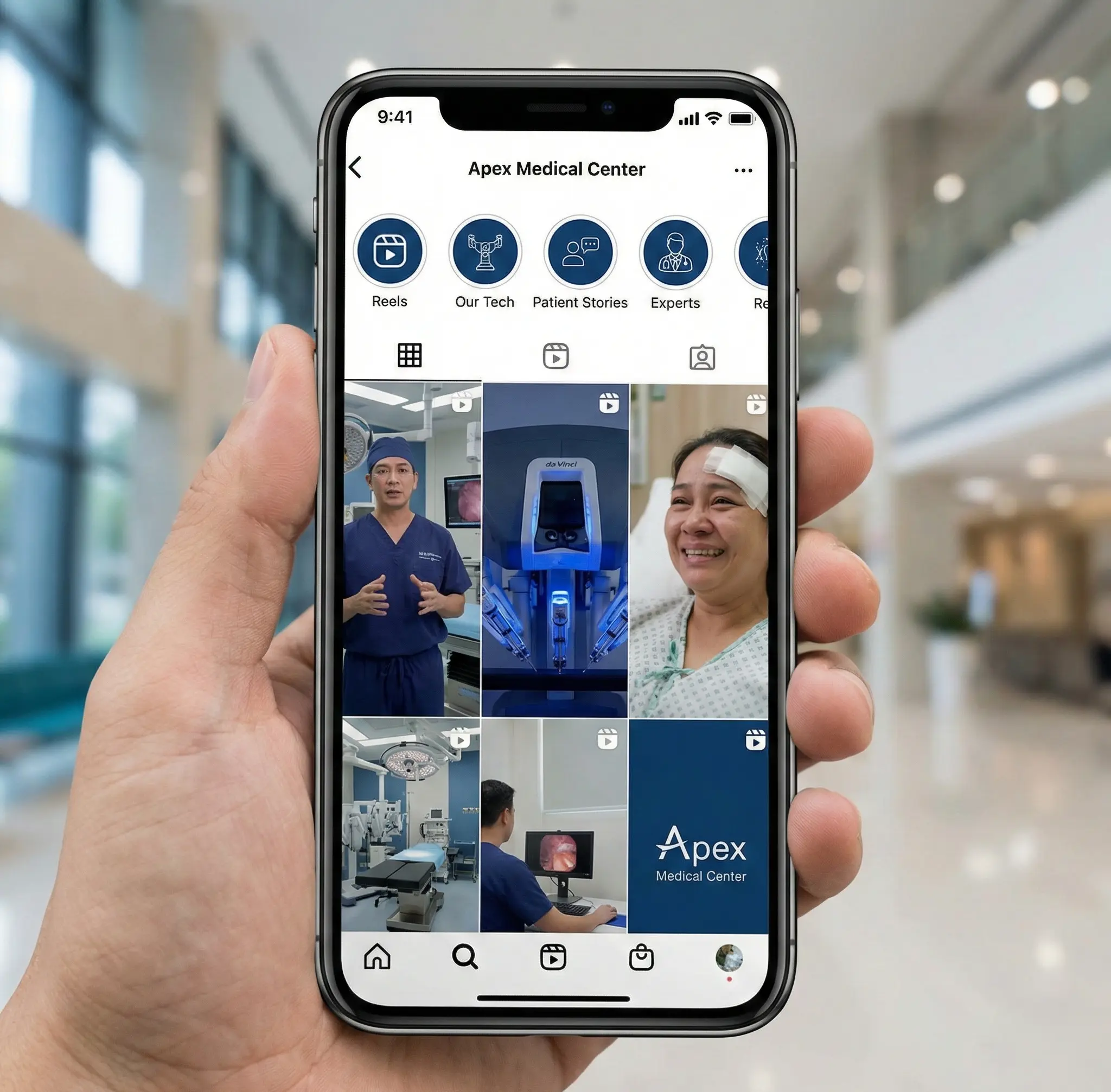
The “Hero Doctor” Video Strategy
Most hospitals fail at social media because they treat it as an online notice board. Patients care about their health. Your doctors are your biggest marketing assets. Include a robust video content plan:
- Myth-Busting Reels: Have your HODs quickly debunk common medical myths.
- Patient Success Stories: Professionally shoot emotional journeys of successful complex surgeries. This is the ultimate social proof.
- “Behind the Scenes” of Tech: Did you just buy a Da Vinci Robot? Show it off! Film a sleek video explaining how this technology makes surgeries safer.
Chapter 6: Patient Retention and CRM Automation
Acquiring a new patient is 5 times more expensive than retaining an existing one. For a multi-specialty hospital, cross-selling and patient retention should make up 30% of your revenue.
Implementing a Healthcare CRM
When a patient visits for a routine orthopedic checkup, does your system automatically tag them? If they are over 50 years old, your CRM should automatically trigger a WhatsApp or Email campaign 3 months later offering a “Senior Citizen Cardiac Screening.”
The Post-Discharge Nurture Sequence
Marketing doesn’t stop when the patient is discharged. Set up automated sequences: Day 1 asking about pain levels, Day 7 providing dietary guidelines, and Day 30 reminding them to book a follow-up. This turns a one-time patient into a lifelong brand ambassador.
Chapter 7: Online Reputation Management (ORM) at Scale
In a multi-specialty hospital seeing thousands of patients a month, negative reviews are inevitable. A delay in the billing department or cold food can result in a 1-star review on Google, even if the surgery was flawless.
The Automated Review Engine
You cannot manually ask thousands of patients for reviews. Integrate your billing software with an SMS gateway. When a bill is settled, they receive a message rating their experience. Ratings of 4 or 5 go to Google Maps; ratings of 1, 2, or 3 go directly to your grievance officer, preventing public fallout.
Crisis Communication Protocol
When a public negative review happens, speed is critical. Have pre-approved response templates ready. Acknowledge the frustration, apologize, and move the conversation to a private phone call immediately.
Chapter 8: Analytics – Tracking Clinical ROI, Not Just Clicks
The final piece of a successful digital marketing strategy for multi specialty hospitals is financial accountability. Most agencies send monthly reports showing “Website Traffic” and “Ad Impressions.” This is meaningless to a Hospital Board of Directors.
The “Cost Per Acquisition” (CPA) Dashboard
At Peakora, we build dashboards that track actual revenue by integrating your campaigns with your Hospital Management System (HMS). You should see exactly how much you spent on ads, how many leads converted to OPD consultations, and how many became surgical procedures.
When you track data at this granular, department-by-department level, marketing stops being an “expense” and becomes a predictable “revenue engine.”

Conclusion: Choosing the Right Partner for the Giant
Executing a digital marketing strategy for multi specialty hospitals requires more than just a standard digital agency. It requires a partner that understands medical ethics, patient psychology, NMC guidelines, and complex organizational structures. It requires a fusion of high-level financial strategy and cutting-edge digital execution.
If your hospital is relying on outdated marketing methods, or if your current agency is treating your massive facility like a simple pizza shop by just running generic Facebook ads, you are leaving millions of rupees in clinical revenue on the table.
The Peakora Advantage
At Peakora, led by visionary financial and digital strategists, we specialize in building proprietary Patient Acquisition Systems exclusively for the healthcare sector. We align our marketing metrics directly with your hospital’s financial goals. Are you ready to stop fighting for patients and start dominating your regional healthcare market?
Contact Peakora today for a comprehensive, multi-departmental Growth Strategy Audit. We will analyze your current digital footprint, your local competitors, and show you exactly where the gaps in your patient pipeline are.

Transform Your Hospital’s Digital Growth Today
Stop letting your competitors steal your patients. Contact Peakora today for a comprehensive, multi-departmental Growth Strategy Audit. We will show you exactly how to scale your clinical revenue.
Contact Peakora Healthcare Marketing