
Medical Website Design Best Practices 2026: From Traffic to Patient Appointments
Introduction: The Death of the “Digital Brochure”
Ten years ago, a medical website was simply a digital business card. It had a picture of the building, a list of doctors, and a phone number. If you treat your website like a digital brochure in 2026, you are actively losing hundreds of high-value patients to your competitors every single month.
Today, your website is your 24/7 Digital Receptionist, your most aggressive marketing asset, and the absolute center of your patient acquisition ecosystem.
Patients are making critical healthcare decisions based on their digital experience. If your website takes four seconds to load, looks outdated on a smartphone, or makes it difficult to find a booking link, the patient will immediately hit the “back” button and book an appointment with the clinic down the street. In the medical sector, digital friction equals lost clinical revenue.
To dominate your local healthcare market, you need a website architected for trust, speed, and conversions. Here are the ultimate medical website design best practices for 2026 that will transform your site from an IT expense into a predictable revenue engine.
Chapter 1: The “Above the Fold” Psychology (The 3-Second Rule)
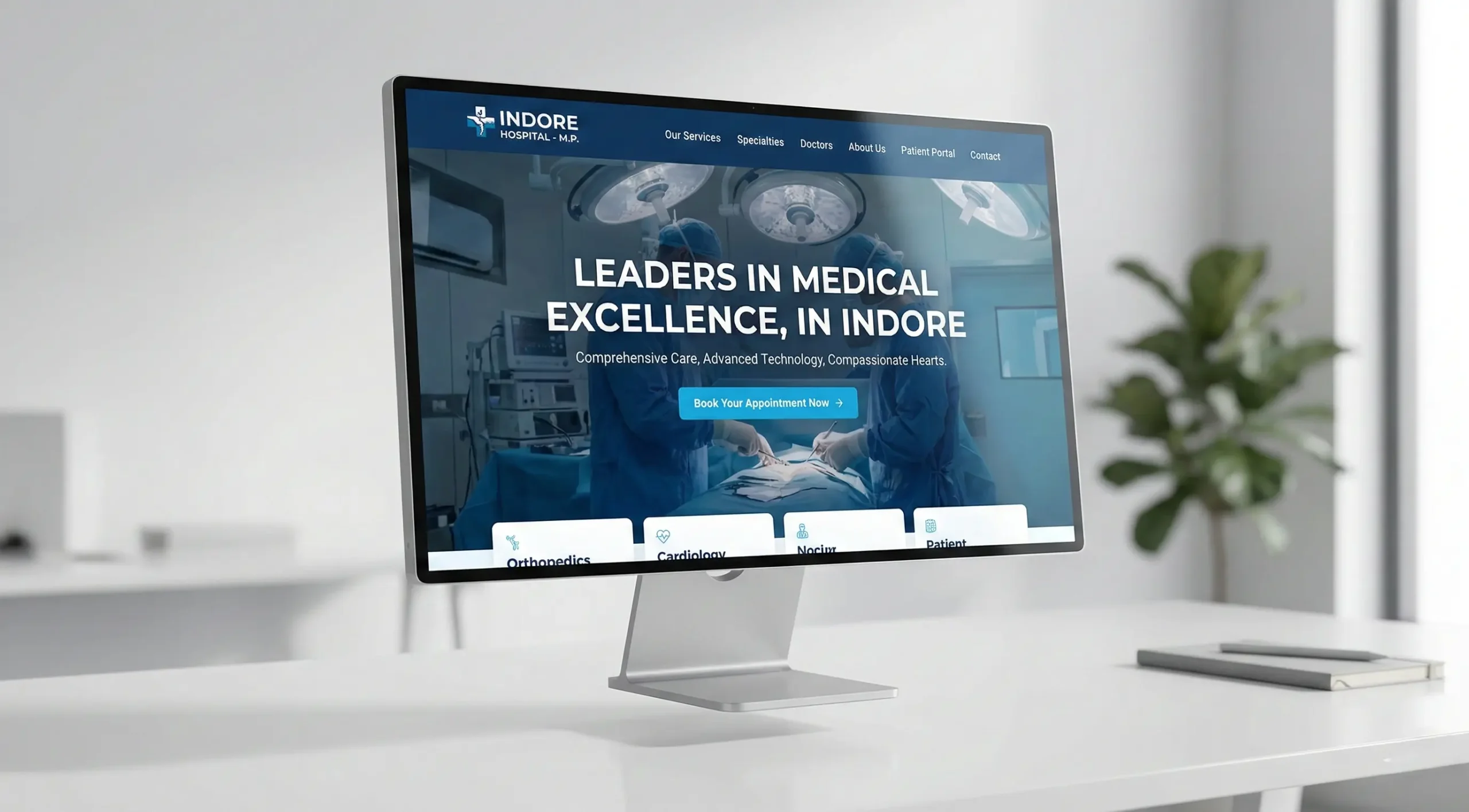
When a patient in pain or distress lands on your website, you have exactly three seconds to answer three subconscious questions:
- Where am I?
- Can they solve my specific medical problem?
- What do I do next?
The area of your website visible before the user scrolls down is called “Above the Fold.” This is the most expensive digital real estate you own.
The Perfect Medical Header:
- Clear Value Proposition: Ditch the generic “We care for your health” slogans. Use aggressive, clear positioning: “Advanced Robotic Joint Replacement in Mumbai” or “Painless Pediatric Dentistry for Anxious Children.”
- The “Hero” Visual: Stop using stock photos of fake doctors smiling at clipboards. Use a high-quality, professional video loop or an authentic image of your actual lead surgeon interacting with a real patient. Authenticity breeds immediate trust.
- The Dual CTA (Call to Action): You need a primary and a secondary action.
- Primary (High Contrast Button): “Book an Appointment” or “Schedule Consultation.”
- Secondary (Lower Contrast): “Call Emergency / Front Desk: +91-XXXXX.”
The Sticky Navigation Bar
As the user scrolls down to read about a treatment, the navigation bar must “stick” to the top of the screen. The “Book Now” button and the phone number must follow them down the page. Never make a patient scroll back to the top just to find your contact details.
Chapter 2: Mobile-First is Dead. Welcome to the “Mobile-Only” Era
In 2026, designing a website for desktop first and then “making it fit” on mobile is a recipe for disaster. Over 82% of healthcare-related searches happen on a mobile device.
The “Thumb-Friendly” UI/UX:
- Bottom Navigation Bars: Phone screens are getting larger. Reaching the top-left corner for a hamburger menu is annoying. Implement bottom-sticky navigation for core actions (Call, Find Us, Book) similar to mobile apps.
- Tap Targets: Make sure your buttons and links are large enough to be tapped with a thumb without accidentally clicking the wrong link (Google recommends a minimum of 48×48 CSS pixels).
- Click-to-Call Functionality: Every single phone number on your website must be a clickable link. If a patient has to highlight, copy, and paste your number into their dialer, you have failed the UX test.
Chapter 3: Frictionless Patient UX and Online Scheduling
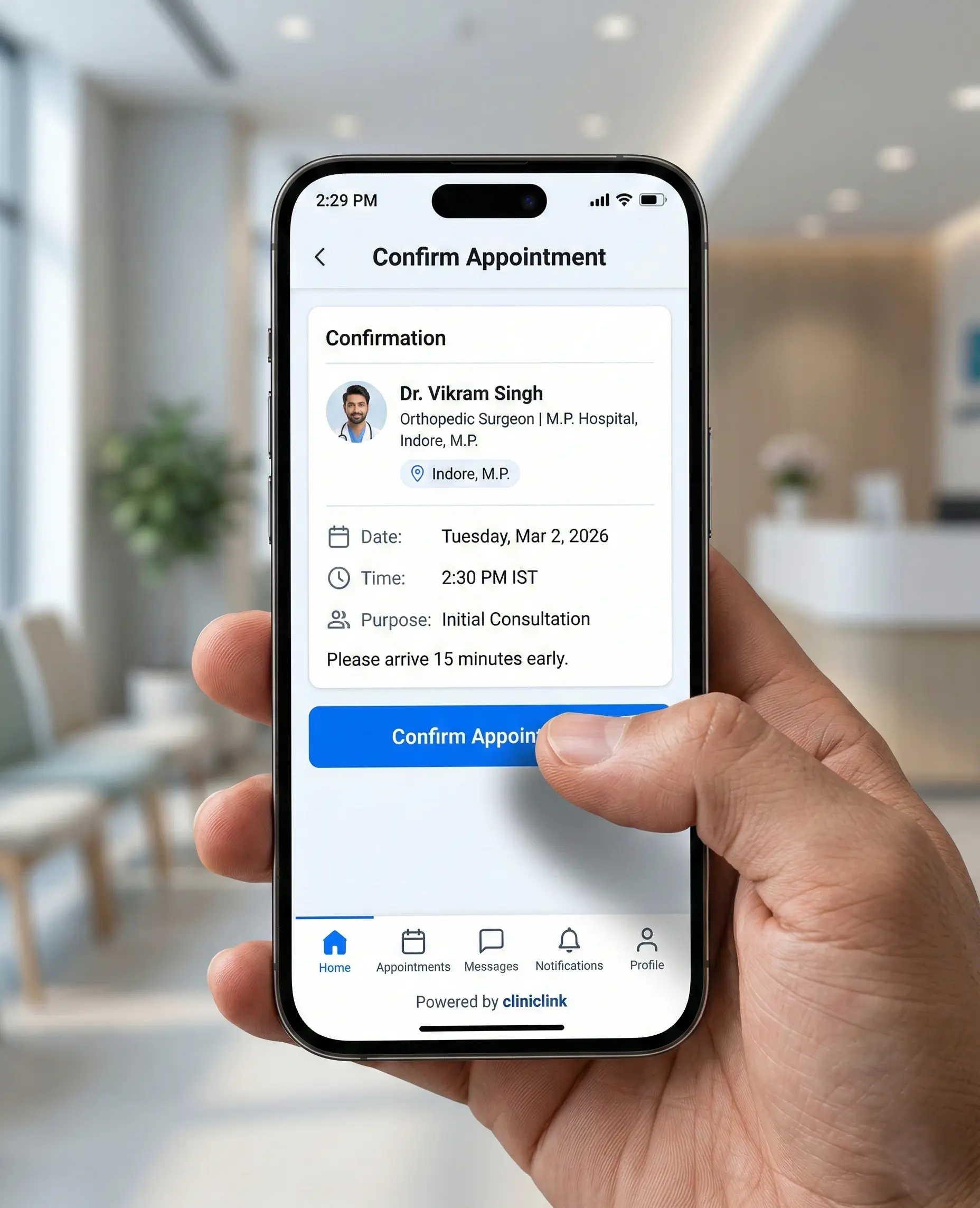
The modern patient expects the Amazon or Uber experience in healthcare. They do not want to fill out a 20-field contact form and wait 24 hours for a receptionist to call them back during their busy workday.
The Direct Booking Integration
Your website must integrate directly with your Hospital Management System (HMS) or Practice Management CRM.
- Allow patients to select their specific doctor, see real-time calendar availability, and book a confirmed slot instantly.
- The UX Rule: The booking process should take no more than 3 clicks.
The “Digital Triage” Chatbot
Integrate an AI-powered, HIPAA/NMC-compliant chatbot. If a user visits the “Cardiology” page at 2:00 AM, the chatbot should gently prompt: “Are you experiencing chest pain right now, or looking to schedule a routine checkup?” If they select chest pain, the bot should immediately display emergency contact protocols. If it’s routine, it guides them to the booking calendar.
Chapter 4: Structuring for E-E-A-T (The SEO Goldmine)
Google holds medical websites to the highest possible standard, known as YMYL (Your Money or Your Life). If Google does not explicitly trust the medical information on your website, you will never rank on the first page.
To rank in 2026, your website architecture must aggressively display Experience, Expertise, Authoritativeness, and Trustworthiness (E-E-A-T).
1. The “Silo” Architecture for Multi-Specialty Clinics
Do not list all your services on one massive drop-down menu. Create dedicated “Silos” (Hub and Spoke models).
- Hub: /orthopedics/ (Introduces the department, HOD, and general facilities).
- Spoke: /orthopedics/knee-replacement/ (Specific procedure page with detailed FAQs, surgical techniques, and recovery times).
This proves to Google that your website is a comprehensive encyclopedia of medical knowledge for that specific specialty.

2. God-Level Doctor Profiles
A doctor’s profile page is often the second most visited page after the homepage. It must not read like a boring CV.
- Include high-resolution headshots and a 60-second introductory video.
- List all board certifications, medical licenses, and academic publications with external links to PubMed or medical journals.
- The SEO Secret: Link the doctor’s profile as the “Author” of your medical blog posts. This tells Google’s algorithm: “This article on Diabetes was written by a verified Endocrinologist.”

Chapter 5: Visual Storytelling (Ditching the Stock Photos)
Trust is the currency of healthcare. Nothing destroys trust faster than a patient recognizing the same generic stock photo of a “smiling female doctor” on your website that they saw on a competitor’s site.
Invest in Authentic Media
- The Facility Tour: Patients are anxious about visiting hospitals. Use high-quality photography to show a clean, well-lit reception area, modern surgical theaters, and comfortable recovery rooms.
- The Equipment as the Hero: Did you invest in a 3-Tesla MRI, a Dental Laser, or a Da Vinci Surgical Robot? Showcase it! Patients equate modern technology with safer, better medical outcomes.
- Video Testimonials: Written reviews are great, but a 30-second video of a patient talking about how a surgeon cured their chronic pain is the ultimate conversion tool. Ensure you have written consent to comply with privacy laws.

Chapter 6: Data Privacy, NMC Guidelines, & Security Compliance
Medical website design in 2026 is a legal minefield. A data breach or an unethical marketing claim can cost you your medical license.
SSL and Server Security
Your site must have an SSL certificate (HTTPS), but that is just the bare minimum. You must use dedicated, secure hosting environments with Web Application Firewalls (WAF) to protect against DDoS attacks. Medical databases are prime targets for ransomware.
Marketing Ethics (NMC/IMA Compliance in India)
If you are operating in India, your website copy must adhere strictly to National Medical Commission (NMC) guidelines.
- No Guarantees: You cannot use words like “100% Guaranteed Cure,” “Magic Remedy,” or “Number 1 Doctor.”
- Transparent Qualifications: Doctor qualifications must be listed exactly as recognized by the medical council.
- Before & After Photos: If you use them (common in plastic surgery or dentistry), they must be authentic, un-retouched, and accompanied by a clear disclaimer stating that individual results may vary.
Data Collection & GDPR/HIPAA
Even if you are not in the US or EU, treating patient data with HIPAA/GDPR-level respect builds massive brand equity. Your contact forms must have explicit consent checkboxes before a patient submits their phone number or medical history. Your Privacy Policy must be easily accessible in the footer.
Chapter 7: Core Web Vitals (The Technical SEO Foundation)
You can have the most beautiful design in the world, but if the code underneath is bloated, Google will penalize you. Google ranks websites based on Core Web Vitals—metrics that measure real-world user experience.
The Big Three Metrics:
- Largest Contentful Paint (LCP): How fast does the main image or text load? For medical sites, this must be under 2.5 seconds. We achieve this by converting all images to next-gen WebP formats and utilizing advanced caching.
- Interaction to Next Paint (INP): When a patient clicks the “Book Appointment” button, how fast does the site react? High INP means the site feels laggy and broken. We use clean, minified JavaScript to ensure instant responsiveness.
- Cumulative Layout Shift (CLS): Does the text jump around as images load? This is incredibly frustrating for users. We hard-code dimensions for all visual elements so the page layout remains completely stable as it loads.

Chapter 8: Web Accessibility (WCAG 2.2) for Inclusive Healthcare
Healthcare is for everyone. If an elderly patient with poor eyesight or a user with motor disabilities cannot navigate your website, you are failing your duty of care (and potentially facing legal issues).
Implementing Web Content Accessibility Guidelines (WCAG 2.2) is no longer optional in 2026.
Crucial Accessibility Features:
- Color Contrast: The text must have a high contrast ratio against the background. Light grey text on a white background is completely unreadable for visually impaired patients.
- Screen Reader Optimization: Every image must have a descriptive alt-text tag so software can read the image description aloud to blind users.
- Keyboard Navigation: Users should be able to navigate your entire website, fill out forms, and book appointments using only the “Tab” and “Enter” keys on a keyboard, without needing a mouse.
- Scalable Typography: Patients must be able to zoom in up to 200% without the website layout breaking or text overlapping.
Chapter 9: Content Strategy – Answering the “Unasked” Questions
A beautiful website is just an empty shell without high-converting copywriting. Medical copywriting is fundamentally different from standard e-commerce copy. It requires empathy, authority, and clarity.
The “Pre-empting Anxiety” Strategy
Patients are scared. Your website content should act as a digital counselor.
Instead of just saying “We do Knee Replacements,” create an interactive FAQ section:
- Will I be awake during the surgery?
- How long until I can walk up the stairs again?
- Does my insurance cover this specific implant?
Pricing Transparency (The Ultimate Trust Builder)
While you cannot give exact surgical quotes online without a diagnosis, clinics that offer “Pricing Ranges” or “Financing Options” pages see a massive increase in lead quality. When you hide the financial aspect, patients assume you are too expensive and leave. Explaining your 0% EMI options directly on the procedure page dramatically increases conversion rates.
Conclusion: Your Website is Your Most Profitable Asset
Implementing these medical website design best practices for 2026 is the difference between surviving and dominating.
A standard web designer sees a website as a collection of colors, fonts, and images. They build you a digital brochure.
A healthcare growth architect sees a website as a funnel. They understand patient psychology, medical compliance, E-E-A-T, and high-intent local SEO. They build you a machine that turns raw internet traffic into booked clinical revenue.
If your clinic or hospital is relying on an outdated, slow, or generic website, you are putting a ceiling on your growth. You are forcing patients to go to the corporate chain down the street simply because their digital experience was smoother.
It’s Time to Upgrade Your Digital Practice
At Peakora, we do not build generic websites. We engineer high-performance, compliant, and visually stunning digital growth ecosystems exclusively for the healthcare industry. Our dual expertise in elite web development and medical marketing ensures that your website doesn’t just look good—it ranks, it converts, and it scales your practice.
Ready to build a predictable patient acquisition engine? Stop losing patients to bad design. Contact the specialists at Peakora today for a comprehensive Digital Architecture Audit.

Transform Your Hospital’s Digital Growth Today
Stop losing patients to bad design. Let Peakora build a high-converting digital clinic for you.
Book a Strategy Call